
"Europe can do nothing about the end of the disc": what the law actually says
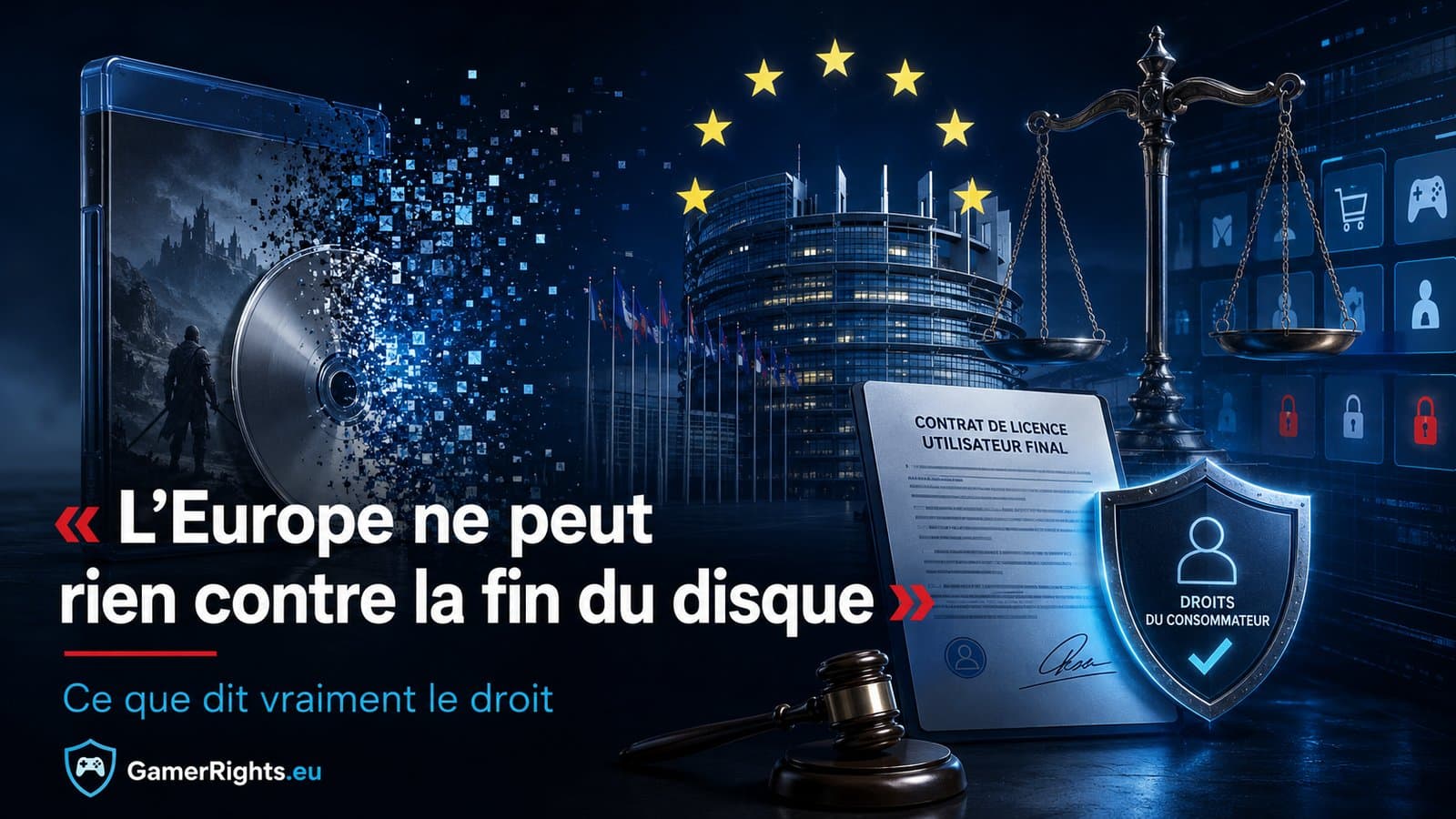
Petitioned by players after the announcement that PlayStation disc production will end in January 2028, the European Commission has replied, and its answer made headlines: "Europe cannot go against PlayStation's decision". Legally, that is correct. But stopping there misses the real story. Here is our analysis.
What was actually said
Questioned by reporters at the European Parliament in Strasbourg in July 2026, Michael McGrath, the European Commissioner for Democracy, Justice, the Rule of Law and Consumer Protection, stated:
"Companies are free to offer games and services in the manner that they see fit, provided that consumer rights are fully protected, in line with national and EU law."
In plain terms: the Commission will not intervene, and will not propose any law forcing Sony (or anyone else) to keep a physical format alive. The decision falls, in his words, under "commercial and contractual freedoms".
Why, as a matter of law, he is right
- Freedom to conduct a business is a fundamental EU right. Article 16 of the Charter of Fundamental Rights protects the freedom to conduct a business, which includes choosing one's products, formats and distribution channels. Forcing a manufacturer to keep pressing discs would be a direct interference with that right, requiring a solid legal basis and a proportionate public-interest justification.
- Consumer law governs how things are sold, not what companies manufacture. The main texts applicable to video games (Directive 2019/770 on digital content and services, Directive 2011/83 on pre-contractual information and withdrawal, Directive 93/13 on unfair terms) impose obligations of conformity, transparency and contractual balance. None of them imposes, or allows anyone to impose, a distribution medium.
- No EU competence covers this case. The Union harmonises the internal market and protects consumers; it has no legal basis to dictate the product format of a private company that otherwise complies with the law. Neither the DSA (Regulation 2022/2065, which targets platforms) nor the DMA (Regulation 2022/1925, which targets gatekeepers) applies to this question.
On this point the case is clear: those hoping Brussels would "block" Sony's decision were expecting something that current EU law simply does not allow.
Where the answer deserves to be turned around
The interesting part of McGrath's statement is not "companies are free". It is the condition: "provided that consumer rights are fully protected". Because that is exactly where things fall apart. Which rights, concretely, protect the buyer of a 100% digital game?
- You are not buying a good, you are accepting a licence. Revocable, non-transferable, modifiable, as every EULA that nobody reads makes clear.
- The second-hand market disappears in practice. French courts have definitively refused the resale of digital games (Paris Court of Appeal, 21 October 2022, upheld by the Court of Cassation on 23 October 2024, UFC-Que Choisir v Valve, appeal no. 23-13.738). As long as discs existed, there was still a market for resale, lending and passing games on. The end of the disc extinguishes that market without any legislator ever deciding it: a purely industrial decision produces an effect no law has voted. See our full analysis on resale.
- Preservation is not guaranteed. Legal deposit schemes cover digital games poorly and server-dependent games not at all. When a store closes or a server shuts down, a game can vanish, even one "bought for life".
In other words: the end of the disc is legal, but it shifts the entire weight of your rights onto a digital framework that largely remains to be built. Saying "consumer rights are fully protected" in the present tense describes a body of law that protects the act of purchasing, not what players mean by owning, lending, reselling and preserving.
The real battle: the Digital Fairness Act
It is no coincidence that this statement comes one month after another missed appointment: on 16 June 2026, the Commission answered the Stop Destroying Videogames European Citizens' Initiative (nearly 1.3 million signatures) by declining any legislative proposal, favouring an industry dialogue and a code of conduct instead. Our detailed analysis is here.
But the case is not closed, and this is the part the "Europe can do nothing" headlines systematically leave out:
- On 9 June 2026, around 45 MEPs from across the political spectrum (EPP, S&D, Renew, Greens, Left and non-attached members) wrote to Commission President Ursula von der Leyen, Executive Vice-President Henna Virkkunen and Commissioner McGrath demanding a "concrete legislative proposal", warning that a failure to act would "send a catastrophic signal to all EU citizens".
- Since the 16 June refusal, the movement has refocused on amending the Digital Fairness Act, the upcoming EU text on digital fairness currently in preparation at the Commission, to include game preservation and end-of-life obligations.
McGrath is telling the truth: under current law, the EU cannot prevent the end of the disc. But law is not a state of nature, it can be changed. Nobody is seriously asking to force Sony to press discs in 2028. What is at stake is something else: that the all-digital era finally comes with rights equivalent to those the physical medium gave us by default, in the spirit of the "6 guarantees" proposed by GamerGen: transparency before purchase, regulated resale, end-of-life obligations, heritage preservation.
Meanwhile, the fight is shifting to different ground
McGrath's statement closes one door: consumer law and freedom to conduct a business. But while it closes, other proceedings are moving forward elsewhere, on entirely different legal ground that the Commission's answer does not cover: competition law.
- Netherlands: the foundation Stichting Massaschade & Consument is pursuing a class action (the "Fair PlayStation" campaign) seeking around $457 million in damages on behalf of 1.7 million Dutch PlayStation users. An important detail: this action is not a reaction to the announcement, it predates it and targets the "Sony tax", the 30% commission levied on everything sold through the PlayStation Store; the case reached court in late June 2026, days before the end-of-disc announcement, which has since handed it its best argument. Its chair, Lucia Melcherts: "The end of physical discs removes the last place where a PlayStation game could still be bought and sold at a competitive price. No discs means no second-hand market and no alternative to the PlayStation Store: from 2028, Sony alone decides what a game costs." The filing cites Demon's Souls, which has stayed at €79.99 on the PlayStation Store since 2020 while its physical retail price dropped rapidly. A similar class action against the PlayStation Store's 30% commission is also under way in the United Kingdom.
- Mexico: federal deputy Iraís Reyes and senator Luis Donaldo Colosio have announced a complaint before the Comisión Nacional Antimonopolio (Mexico's competition authority) over alleged monopolistic practices: they are asking for an investigation, for Sony's plan to be suspended while it runs, and for guarantees on reselling, lending and collecting games. Their phrase sums up the issue: without discs, "Sony would be judge and party to everything: the console, the store, distribution and price". They add concerns specific to the Mexican market: the disappearance of the second-hand market and of lending games between friends, and the requirement to download 100 to 150 GB games in regions with insufficient connectivity.
- Brazil: federal deputy Erika Hilton has requested an investigation into Sony, arguing that the end of the disc restricts reselling, lending and preservation and ignores players with poor connectivity, in possible breach of Brazil's Consumer Protection Code. Procon-SP, São Paulo's consumer protection agency, publicly reminded Sony that the transition to all-digital will have to respect consumer rights, whether people buy physical or digital.
This is an angle our analysis above did not cover: consumer law does not protect the format, but competition law is concerned with dominant market position and the absence of pricing pressure, regardless of any format question. Nothing has been ruled on yet, but these proceedings show that "Europe can do nothing" does not mean "nobody can do anything".
And while Brussels declines to legislate, Brasilia is writing a law
Brazil is not stopping at an investigation. Federal deputy Jandira Feghali has filed bill PL 3612/2026, directly inspired by Stop Killing Games and grounded in two existing texts: the Consumer Protection Code and the Marco Legal dos Games, Brazil's framework law for the video game industry. Its content looks strikingly like what European players were asking the Commission for:
- clear disclosure, before purchase, when a game depends on a permanent connection to servers;
- a minimum support period of two years after release in Brazil;
- at least 180 days' notice before any server shutdown, displayed in the game, on digital stores, on official channels and where possible by email;
- voluntary heritage deposit of games with competent institutions;
- a framework allowing the community to keep servers running without infringing copyright.
It is only a bill, not a law: it can be amended, buried, or passed. But it proves the essential point: nothing prevents a parliament from doing exactly what the European Commission currently declines to propose. In a country where, according to the Pesquisa Game Brasil 2026 survey, around 82% of the population plays video games, the political argument carries weight.
The precedent that worries people: Apple, Google, and the single channel
The parallel with the Dutch action is not trivial. Apple and Google were sued (Epic Games v. Apple, Epic Games v. Google) precisely for making their own store the sole entry point onto their platform, with no alternative payment or distribution option. Google lost across the board (jury verdict, December 2023) and eventually settled: the Play Store is due to open to third-party stores starting 22 July 2026, with commissions capped at 20% (a settlement still awaiting the judge's final approval, expected in summer 2026). Apple, for its part, can no longer charge a commission on payments made through an external link, under a court remedy the US Supreme Court declined to stay in May 2026 (its appeal will be argued before the Court later in 2026, with a ruling expected sometime in 2027).
The common thread with PlayStation: by removing the disc, Sony turns the PlayStation Store into the only possible channel to buy a game, exactly the situation that proved costly for Apple and Google. The Digital Markets Act (Regulation 2022/1925), which is precisely what forced those two giants' stores open in the EU, currently designates seven "gatekeepers" (Meta, Alphabet, Amazon, ByteDance, Apple, Booking, Microsoft) but no console maker. Political and industry voices called in 2026 for PlayStation, Xbox, Nintendo and Steam to be brought under the same regime.
One difference remains, and it has so far largely shielded consoles from this type of lawsuit: unlike a smartphone, you choose your console before buying games, which supports the argument that competition plays out at the moment you buy the console itself, not afterwards (and that the closed ecosystem, often subsidised by consoles sold at a loss, is part of the model the buyer accepts). But a fully digital market, with no distribution alternative whatsoever once the console is bought, is precisely the ground on which that reasoning is weakest: that is exactly the angle the Dutch plaintiffs are testing.
Key takeaways
- Yes, Sony is within its rights: commercial freedom is protected by Article 16 of the EU Charter of Fundamental Rights.
- Yes, the Commission is telling the truth: no European consumer-protection text allows anyone to impose a distribution format on a company.
- But "consumer rights are fully protected" describes the right to buy, not the right to own: resale has died in court (Cassation, 2024), preservation is guaranteed by nothing, and the licence remains revocable.
- Another front is already open, outside the ground covered by McGrath: competition law, being tested in the Netherlands ("Fair PlayStation" class action, $457M) and Mexico (complaint before the antimonopoly authority).
- The single channel created by the end of the disc echoes the pattern that proved costly for Apple and Google (Epic Games v. Apple/Google): but no console maker is currently designated a "gatekeeper" under the Digital Markets Act, despite 2026 calls to change that.
- Brazil is showing the legislative path: an investigation requested into Sony, a reminder from Procon-SP, and above all bill PL 3612/2026 (transparency on server dependency, minimum two-year support, 180 days' shutdown notice, preservation), precisely what the Commission currently declines to propose.
- The lever is therefore not banning the end of the disc: it is securing, in the Digital Fairness Act, digital rights that genuinely replace what the disc guaranteed in practice, while letting competition law do its work on pricing.
The Commission says it cannot save the disc. Nobody was really asking it to. What we are asking is that the rights the disc carried do not die with it.
Also read: PlayStation ends disc production in 2028 · Our analysis of the Commission's response to Stop Destroying Videogames · Reselling digital games: laws, contradictions and remedies
References
- Gamekult, "L'Europe ne peut pas aller contre la décision de PlayStation" (July 2026, in French)
- GamesRadar+, Commissioner McGrath's statement (original quote)
- TechSpot, "EU says it can't stop Sony from ending physical PlayStation game releases"
- Clubic, "Pays-Bas, Mexique : les actions en justice se multiplient contre PlayStation" (14 July 2026, in French)
- PC Gamer, the Stichting Massaschade & Consument "Fair PlayStation" action and Lucia Melcherts's statement
- LEVEL UP, the antimonopoly complaint announced in Mexico by Iraís Reyes and Luis Donaldo Colosio (in Spanish)
- Push Square, "Brazil Is Taking On Digital Games Ownership and Preservation"
- Gamers & Games, Jandira Feghali's bill PL 3612/2026 (in Portuguese)
- European Commission, Digital Markets Act: list of designated gatekeepers
- Epic Games v. Apple, case history
- Epic Games v. Google, case history
- Directive (EU) 2019/770 on digital content and services (EUR-Lex)
- European Parliament, Digital Fairness Act legislative train file
- Court of Cassation (France), 1st Civil Chamber, 23 October 2024, appeal no. 23-13.738 (UFC-Que Choisir v Valve)
Rate this article
Comments (0)
Be the first to comment on this article.