
Why petitions will not save your video games
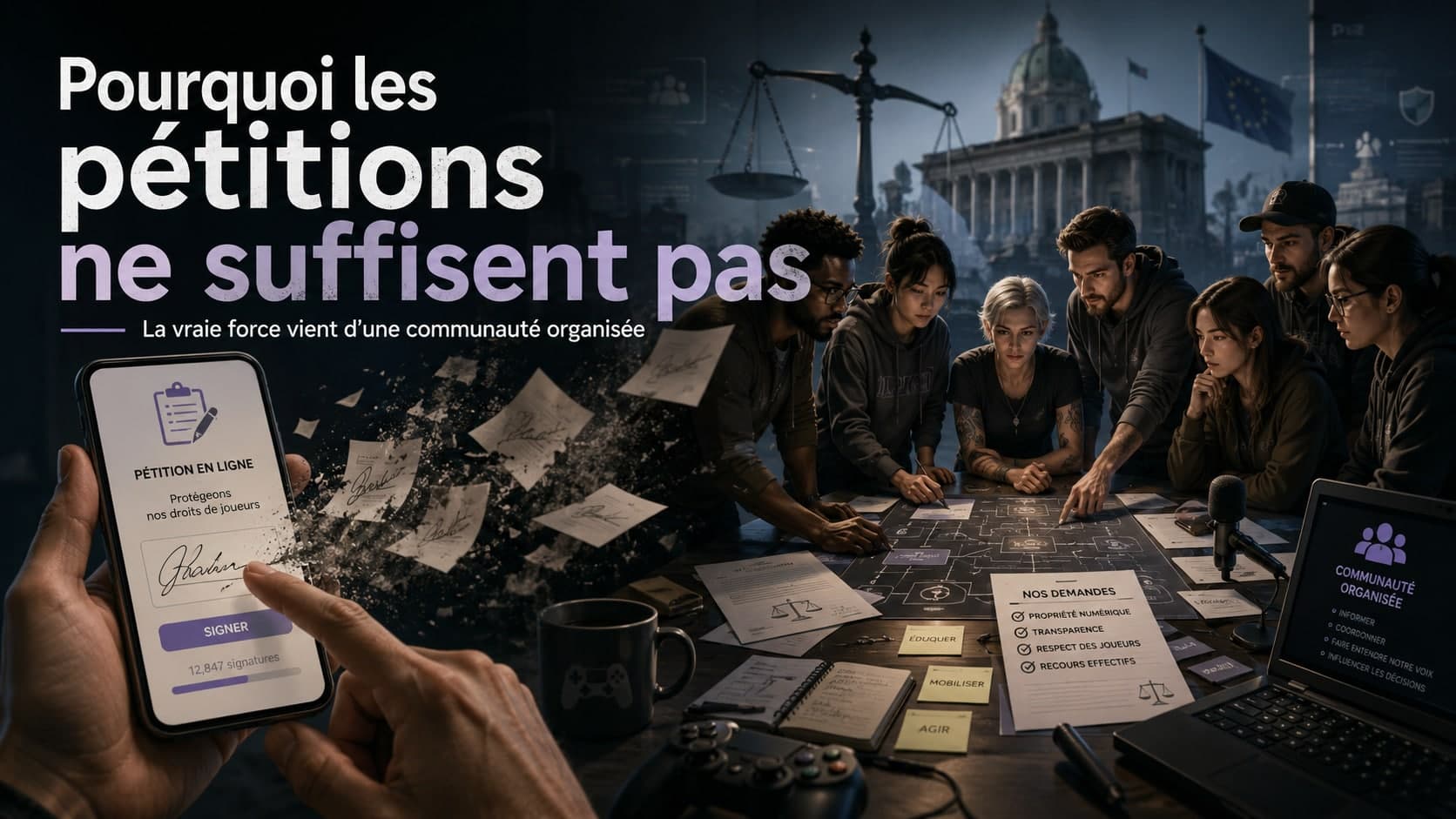
Signing a petition can be useful. But signing alone is not enough.
This may be the hardest point to hear when you are angry: a petition often gives you the feeling that you are taking action, but it does not automatically create leverage.
When a petition starts circulating, it rarely comes from a calm situation. It comes from an abuse, a server shutdown, a game being rendered unplayable, a broken promise, a purchase that increasingly looks like disguised rental, or an industrial decision made with no respect for players.
You see the link. You read the title. You recognise the anger. You sign.
And at that moment, you join that anger.
But you also do something else, something more dangerous: you unload it.
You tell yourself: “I have done my part.”
You signed. Maybe you shared it. Maybe you left a comment. Then life resumes. The game remains shut down. The problem remains. The business model keeps moving forward. But your support becomes invisible again.
That is where the trap lies.
A petition turns collective anger into an individual gesture. It can provide a measure. It can show that an issue exists. It can open a door. But it does not replace a community, a strategy, legal action, political pressure, or an organisation capable of continuing once the emotional moment has passed.
A petition is a thermometer. It is not a treatment.
The problem is not the petition. The problem is believing it is enough
We should not fall into the opposite extreme. A petition is not necessarily useless. In some cases, it can become a public signal. It can help identify people who are affected. It can force media outlets to cover an issue. It can sometimes trigger an official procedure.
But even in the most serious mechanisms, a signature does not mechanically turn into a law.
A European Citizens’ Initiative, for example, is a much more structured instrument than a simple online petition. If it reaches the required thresholds, it can compel the European institutions to examine a request. But that does not mean the request will be accepted as written, nor that legislation will automatically be proposed.
The example of Stop Destroying Videogames is interesting for precisely that reason. The initiative succeeded in bringing a major issue before the European institutions: the ability of some publishers to render video games unusable after their sale or licensing. It gathered more than one million verified statements of support and therefore required the institutions to address the subject. That matters.
But the institutional response also shows the limit of the mechanism: reaching the threshold is not enough to obtain an immediate and strong legal obligation. The European Commission concluded that, at this stage, it could not propose a general obligation to keep games playable after their commercial withdrawal, while announcing other avenues such as discussions with industry, consumer representatives and enforcement of existing law.
That is not proof that the initiative achieved nothing. Quite the opposite: it moved the debate. It forced the issue to exist at the right level.
Nor is the point to rewrite history afterwards, decide who was right and who was wrong, or blame those who tried because they did not immediately obtain the desired result. In this kind of fight, strategic and legal difficulties exist from the outset. Some approaches work, others reach their limits, and we must be able to learn from them without turning every disagreement into a score-settling exercise.
One of the purposes of a lasting organisation is precisely to preserve the memory of what has been tried, understand why some paths produced an effect and why others ran into obstacles, and then use that experience to build what comes next.
A signature, even on a massive scale, is therefore only one step.
The real fight starts afterwards.
The click that lets us off the hook
The main danger of a petition is how comfortable it is.
It lets us participate without truly committing. It provides a simple outlet for a complex indignation. It turns political, legal or social anger into a clean, quick click that costs almost nothing.
That is human. Nobody can spend all day campaigning. Everyone has a life, work, family and personal problems. But large companies do not operate on passing emotion. They operate through strategy, law, lobbying, contracts, communications, timing, financial risk and leverage.
Against that, an isolated petition is weak.
It can make noise for a few days. But if nothing follows, it dissolves. The company waits for the wave to pass. The media move on. Politicians look elsewhere. And players return to their daily lives with the feeling that they have expressed their disagreement.
The problem is that expressed disagreement is not yet power.
Power is a community that stays.
Power is the ability to document abuses.
Power is collective memory.
Power is an organisation that knows whom to talk to, when to talk, how to talk, and with which arguments.
Power is strategy.
David versus Goliath: without a strategy, we lose before we begin
In video games, players are often facing enormous structures: international publishers, closed platforms, legal departments, finance departments, licensing agreements, digital stores, server infrastructures, terms of service, commercial agreements and sometimes even political or industrial interests.
This is not a balanced discussion between two people sitting around a table.
It is David versus Goliath.
And in a David-versus-Goliath fight, it is not enough to say that there are many of us. You need to know where to aim.
Effective action is not merely about generating popular impact. Public support is useful, but it is not enough. Thousands or millions of players can be unhappy without anything changing if that anger creates no concrete consequence for the actor being challenged.
What matters is real impact.
Legal impact.
Regulatory impact.
Sustained media impact.
Economic impact.
Political impact.
Impact on public reputation.
Impact on a company’s ability to continue a disputed practice quietly, without having to justify itself.
That means analysing weak points. Not out of revenge, but for effectiveness. Where can consumer law apply? Where does the commercial promise become ambiguous? Where has the player been misled about the true nature of what they were buying? Where does preservation of video game heritage conflict with practices of total shutdown? Where can institutions act? Where can elected representatives be confronted with their responsibilities?
That work cannot be done with a “sign” button.
It requires time, expertise, method and discretion.
Not everything should be public
There is another difficulty that is rarely discussed: when you are confronting actors far more powerful than you are, you should not hand all your keys to the other side.
A public article can explain a vision. It can mobilise. It can clarify a philosophy. It can explain why organisation is necessary. But it does not necessarily have to expose every legal angle, every avenue of pressure, every identified weakness, every possible contact and every lever under consideration.
An effective community must therefore accept a simple idea: not everyone needs to know everything, but everyone must be able to trust the structure.
That does not mean operating in total opacity. Quite the opposite. Trust must be built through rules, responsibilities, safeguards and appropriate transparency.
But a serious mobilisation cannot operate like a public comment thread.
There need to be different levels of action.
People who document.
People who verify.
People who translate.
People who contact institutions.
People who speak to the media.
People who prepare case files.
People who relay information publicly.
People who simply participate by adding weight to the movement.
Everyone can help. But not everyone has the same role.
That is normal. It is even necessary.
The point is not to create a hierarchy in order to confiscate the movement. The point is to have an organisation so that the movement does not disperse, get manipulated, burn out or turn against itself.
An active community carries more weight than a forgotten petition
The real alternative to a petition is not inaction.
It is an organised community.
An active, united, lasting, European community that can remain mobilised beyond the buzz carries far more weight than a list of signatures forgotten in a database.
Why?
Because a community can act repeatedly.
It can return to an issue.
It can respond to an announcement.
It can produce analyses.
It can challenge elected representatives.
It can compare publishers’ practices.
It can bring forward concrete cases.
It can help journalists understand the technical issues.
It can distinguish real abuses from fake scandals.
It can avoid oversimplifications that discredit the cause.
It can remind people that developers are not all responsible for the industrial decisions made by their management.
It can defend players without falling into hatred of creators.
That is fundamental.
The fight for players’ rights must not become a venting exercise against developers. Many developers are subject to the same industrial logic themselves: shutdowns, platform dependency, absurd directives, business-driven decisions imposed from above, and the disappearance of the cultural works they helped create.
Players and developers are not natural enemies.
Very often, they are on the same side of the problem.
Video games belong to no political party, but players are voters
Video games have one enormous advantage: they belong to no political party.
They are played by people on the left, on the right and in the centre; by people who do not vote; by young people and parents; by developers, workers, engineers, artists, civil servants, freelancers and retirees; by people from every social and cultural background.
Video games are not a political niche. They are a massive popular culture.
That is precisely why they must not be captured by one political party. Defending players must not become an appendage of one political camp. It has to remain cross-party, because the right to know clearly what you are buying, the right not to see a product arbitrarily disappear, the right to cultural preservation and the right to fair information are not party-political issues. They are issues for society as a whole.
But “non-partisan” does not mean “without political weight”.
Players are citizens.
Players are voters.
Players’ parents are voters.
Developers are voters.
Studios are employers.
Video games are a major cultural, economic and technological industry.
The problem is that many political decision-makers still do not understand this. They still too often see video games as a secondary pastime, a subject for teenagers, one entertainment industry among others, or a market that can regulate itself.
That is wrong.
Video games have become a central cultural space. They raise questions of digital ownership, consumption, heritage, access, platform dependency, preservation, technological sovereignty and user rights.
If players want politicians to understand that, they need to make it known in ways that go beyond an isolated petition.
They need to become visible as a civic force.
Not as a party.
Not as an ideology.
As a community of concerned citizens.
What a petition should be: an entry point, not an end point
A petition can be useful if we put it back in its proper place.
It can be an entry point.
It can allow someone to say: “This concerns me.”
It can help recruit people.
It can measure the scale of a problem.
It can open an institutional door.
It can send an initial signal to the media.
But it should never be presented as the final action.
The real message should not be: “Sign and we will win.”
The real message should be: “Sign, then stay with us.”
Sign, then document.
Sign, then join a community.
Sign, then help translate.
Sign, then contact your representative.
Sign, then talk to a journalist.
Sign, then calmly explain the issue to people around you.
Sign, then help build leverage.
The signature must be the beginning of engagement, not its burial.
Why GamerRight must exist
That is precisely why GamerRight.eu must exist.
Not to be one more petition.
Not merely to produce bursts of anger.
Not to scream at the entire industry indiscriminately.
But to build a serious, documented, European and lasting defence of players’ rights.
Video games are changing. Physical media are declining. Licences are progressively replacing the perception of ownership. Servers are becoming points of control. Digital stores lock in libraries. Terms of use are rarely read, often changed and almost always unbalanced. Games can disappear even after they have been purchased, sometimes with no preservation solution, no private server, no offline version and no satisfactory end-of-life plan.
This is not just about nostalgia.
It is not just about collectors.
It is not just about “old games”.
It is about rights.
When a player buys a game, what do they actually own?
When a publisher shuts down a service, what obligations should it have?
When a game depends on a server, what should be clearly disclosed at the time of purchase?
When a work disappears, who defends the collective cultural interest?
When a platform concentrates access, who protects the user?
These questions will not be resolved by a forgotten petition.
They will be resolved through long-term, collective, strategic and European work.
Stop signing just to sleep better
The point is not to tell people: “Never sign a petition.”
The point is to say: “Do not believe that a signature is enough.”
Signing can be a first gesture. But if that gesture merely serves to soothe your conscience, it becomes almost counterproductive. It turns necessary anger into individual relief. It creates the impression that something has been launched when nothing has yet been built.
Players need better than that.
They need a voice.
They need memory.
They need a common space.
They need solid case files.
They need political relays.
They need media relays.
They need the capacity to act over time.
They need a community that does not disappear when the hashtag fades.
A petition can light a fuse.
But without organisation, there is no explosion.
Without strategy, there is no victory.
Without leverage, there is only a signature counter.
And a signature counter, against billions of euros, global platforms and armies of lawyers, is not enough.
What comes next
So the question is not: “Which petition should we sign?”
The real question is: “What force are we capable of building after the signature?”
That is the force we need to build now.
A calm force.
A documented force.
A European force.
A cross-party force.
A force capable of talking to players, developers, journalists, consumer associations, institutions and elected representatives.
A force that understands that video games are no longer a peripheral pastime, but a cultural, economic, technological and democratic issue.
Signing a petition can be the beginning.
But it will never be enough.
To defend our games, our purchases, our memory and our rights, we must stop believing that clicking is the same thing as acting.
We need to organise.
Official references
Rate this article
Comments (0)
Be the first to comment on this article.